





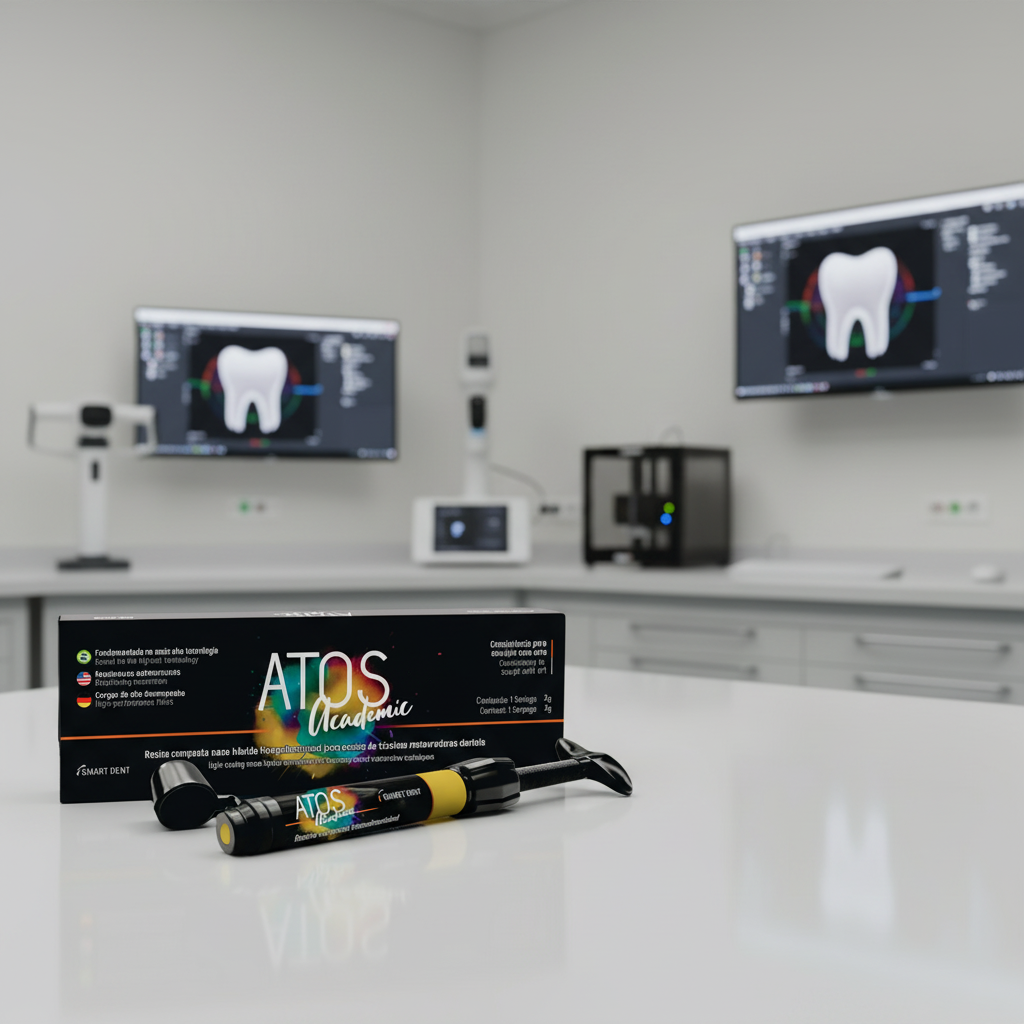
Atos Academic Resin: Scientific and Technological Analysis for Digital Dentistry
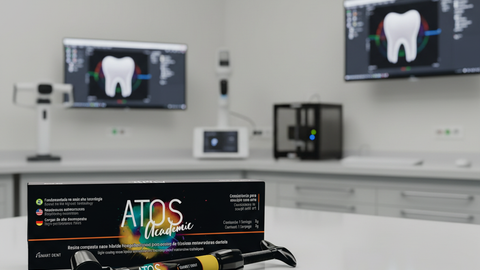
The evolution of digital dentistry drives the demand for restorative materials that combine superior mechanical performance and refined aesthetics. In this context, the Atos Academic light-cured nano-hybrid composite resin, developed by Smart Dent, emerges as a solution for teaching and clinical practice, promising property optimization through an innovative formulation. This technical article explores the scientific and technological claims underlying this material, focusing on its composition, mechanism of action, and potential impact for dentists, prosthetists, and technicians in the Brazilian market.
📊 Quick Technical Summary
Atos Academic resin is a light-cured nano-hybrid composite resin, designed to optimize mechanical and aesthetic properties. Its formulation with structuring monomers and high-performance fillers aims to reduce polymerization shrinkage and maintain gloss, meeting the needs of direct restorative materials.
- Classification: Nano-hybrid Composite Resin
- Main Fillers: Barium-Aluminum Glass, Silica Nanoparticles, Zirconium Nano Silicate
- Primary Benefit: Reduction of polymerization shrinkage factor
- Application: Direct restorations, teaching restorative techniques
🔬 The Science Behind: Composition and Performance of Atos Academic Resin
Nano-hybrid
Technological classification that optimizes mechanical and aesthetic properties.
Zirconium Nano Silicate
Key component for polishing gloss and surface smoothness.
Structuring Monomers
Responsible for reducing polymerization shrinkage and color stability.
Atos Academic resin is conceived as a light-cured nano-hybrid composite resin, whose performance is attributed to the synergy between its monomeric matrix and a high-performance inorganic filler system. The nano-hybrid classification implies the incorporation of filler particles of different sizes, including nanoparticles, aiming for a balance between mechanical strength and aesthetic characteristics, such as polishing and gloss retention.
Innovation and Technology
The technology employed in Atos Academic focuses on optimizing essential properties for direct restorations. The use of Zirconium Nano Silicate is a differential, specifically cited for its ability to provide “polishing gloss,” which indicates a concern for post-finishing surface smoothness and the aesthetic longevity of the restoration.
Mechanism of Action
The manufacturer describes the mechanism of action through the function of its components:
- Structuring Monomers: These monomers are attributed with “reduction of the polymerization shrinkage factor, color stability, increased lifespan, thixotropy, and ease of handling.” The reduction of polymerization shrinkage is a critical aspect in composite resins, as it minimizes stress at the tooth-restoration interface, contributing to marginal integrity and clinical longevity.
- High-Performance Fillers: The combination of inorganic fillers is responsible for “ensuring high mechanical and aesthetic properties.”
Detailed Chemical Composition
Although not specifying the exact proportions or specific monomers (such as Bis-GMA, UDMA), the document provides a qualitative description of the components:
| Component | Description in Document | R&D Analysis |
|---|---|---|
| Organic Matrix | "Structuring monomers" | Vague. Does not specify the composition (e.g., Bis-GMA, UDMA, TEGDMA), which is crucial for determining properties such as shrinkage and sorption. |
| Inorganic Filler | • Barium-Aluminum Glass • Silica Nanoparticles • Zirconium Nano Silicate |
Typical of a nano-hybrid resin. Barium provides radiopacity. Nanoparticles fill spaces, increasing strength and polishability. Zirconium Silicate improves polishing and gloss retention. |
| Initiators/Additives | Not cited. | The photoinitiator system (e.g., Camphorquinone) and other additives (inhibitors, pigments) are not mentioned. |
Physicochemical Properties and Mechanical Performance
The document highlights the “reduction of the polymerization shrinkage factor” and “polymerization in a few seconds,” indicating an optimization of polymerization kinetics and generated stress. The claim of “Resistance to ensure durability” suggests adequate mechanical performance, although no quantitative data on flexural strength (MPa), compressive strength (MPa), or shear strength, nor values for sorption, solubility, or depth of cure are provided. The absence of numerical data prevents a direct comparison with technical standards, such as ISO 4049 for restorative materials.
🏆 Authority and Scientific Compliance
The provided document, although detailed in its technological claims, does not present quantitative laboratory test data, references to technical standards such as ISO 4049 for dental composites, or published scientific studies that validate the mentioned properties. Performance validation is presented through expert testimonials, which, although relevant for user perception, does not replace proof through physicochemical and mechanical characterization data in certified laboratories.
Practical Application in the Dental Context and Relevance for the Brazilian Market
Atos Academic resin is positioned as a valuable tool for teaching dental restorative techniques, offering a learning experience that simulates clinical practice. Its formulation, which includes performance fillers such as Zirconium Nano Silicate, Barium-Aluminum glass, and Silica nanoparticles, seeks to replicate the properties of conventional composite resins. The optimization of consistency for artistic and precise sculpting, along with resistance for durability in training, are characteristics that make it relevant for educational institutions and dentistry students in Brazil.
Rapid polymerization and ease of handling, attributed to structuring monomers and thixotropy, contribute to a more dynamic and efficient learning process. The reduction of the polymerization shrinkage factor and color stability are crucial aspects for the realism of simulated restorations, preparing future professionals for the challenges of clinical practice with high-performance materials.
Final Technical Considerations
Atos Academic resin represents an advancement in the formulation of nano-hybrid composite resins, focusing on properties that benefit both learning and clinical application. The emphasis on reducing polymerization shrinkage, color stability, and lasting gloss are indicative of a product developed with relevant technical considerations for the longevity and aesthetics of restorations. However, for a complete scientific evaluation and to support clinical and academic decisions, the availability of quantitative data from mechanical and physicochemical tests, in compliance with international standards such as ISO 4049, would be of great value. Transparency in these data would allow professionals and researchers a more in-depth analysis of the material's performance compared to other products on the market.
💡 Protect Your Clinical Reputation
Use certified materials and follow protocols validated by experts. Invest in quality digital dentistry.
Atos Academic Resin - Yellow: Technical Details and Educational Application
The Atos Academic Resin - Yellow is specifically formulated for teaching dental restorative techniques, aiming for an enhanced learning experience. This disruptive product, a high-quality nano-hybrid composite resin, integrates innovation and technology to facilitate the learning process in Dentistry.
Complete Specifications:
- Classification: Light-cured nano-hybrid composite resin.
- Performance Fillers: Includes Zirconium Nano Silicate, Barium-Aluminum glass, and Silica nanoparticles, which provide high mechanical and aesthetic properties.
- Consistency: Optimized for artistic and precise sculpting, facilitating handling and understanding of dental anatomy.
- Resistance: Developed to ensure durability in effective training.
- Gloss: The presence of Zirconium Nano Silicate contributes to exceptional polishing gloss, increasing the realism of practices.
- Polymerization: Fast, in a few seconds, optimizing class time and student productivity.
- Structuring Monomers: Crucial for reducing the polymerization shrinkage factor, color stability, and increasing the lifespan of simulated restorations.
- Thixotropy: Property that, along with ease of handling, provides an experience very close to conventional composite resin.
This material empowers students to develop more efficient and realistic clinical skills, preparing them for professional practice with confidence. To purchase Atos Academic Resin - Yellow, the price is R$ 54. Consult the purchase URL for more details.
![[COMPARATIVO] - Impressora 3D qual a ideal para chairside print](https://b-vz-004839ee-19a.tv.pandavideo.com.br/8589e7fc-982f-4a12-a303-3f96a31fbee8/thumbnail.jpg)