NanoClean PoD™: Alcohol-Free 3D Resin Cleaning; Optimization
NanoClean PoD™: alcohol-free 3D resin cleaning. Innovation for optical purity and elimination of the "chalk effect" in high-fill prints.
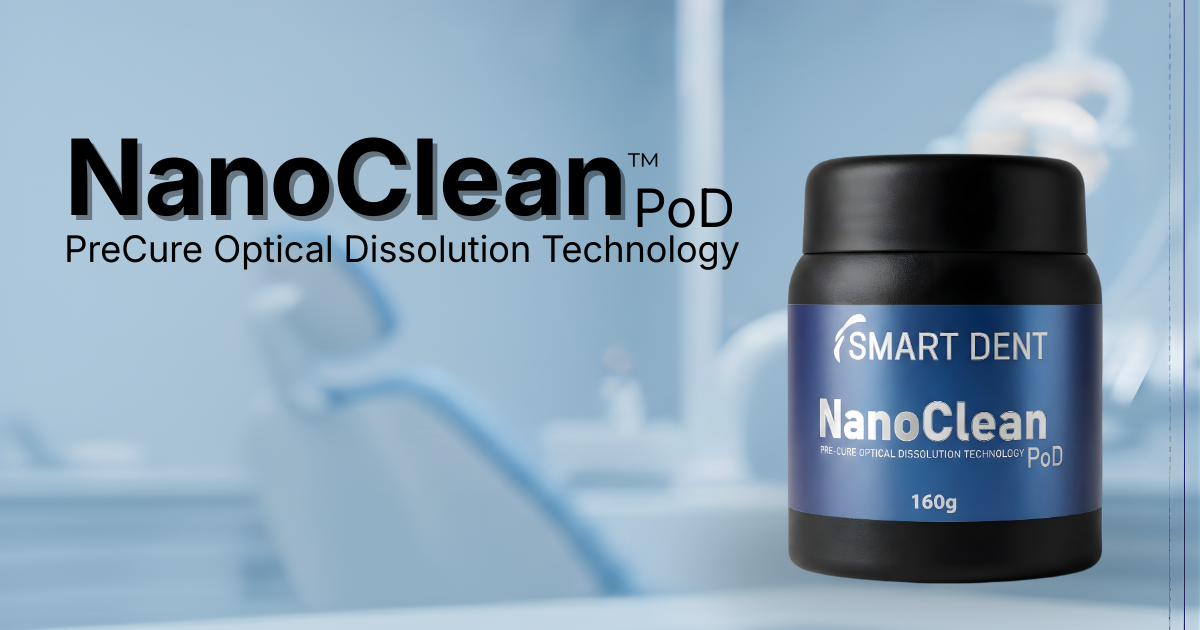
NanoClean PoD™: alcohol-free 3D resin cleaning. Innovation for optical purity and elimination of the "chalk effect" in high-fill prints.
NanoClean PoD™: The Alcohol-Free Solution for Optical Purity of High Inorganic Fill Resins
Smart Dent's NanoClean PoD™ represents an innovation in the post-processing of 3D printed parts, specially formulated for 3D printing resins with high inorganic filler, such as ceramics. This chemical solution, patent pending, fully replaces Isopropyl Alcohol (IPA), eliminating the undesirable "chalk effect" and chemically reorganizing the surface layer. The objective is to maximize the aesthetic fidelity and mechanical performance of the part before post-curing, ensuring visible and reliable results for digital dentistry professionals and dental prosthesis laboratories.
📊 Quick Technical Summary
The application of NanoClean PoD™ shows in internal tests a significant increase in the flexural strength of the analyzed test specimens compared to other cleaning methods, ensuring maximum mechanical and aesthetic performance for high inorganic filler resins.
-
Main Solvent: NanoClean PoD™ (Alcohol-Free Solution)
-
Immersion Time: 60 seconds
-
Flammability: Non-flammable
-
Application: Post-3D printing cleaning of dental parts with high inorganic filler ceramic resins.
Unique Immersion Time
NanoClean PoD™ (PreCure Optical Dissolution Technology) was developed to optimize post-3D printing cleaning, especially for high inorganic filler resins. Its exclusive formulation acts on the chemical reorganization of the surface, eliminating the "chalk effect" and preparing the part for UV post-curing, without the risks associated with the use of IPA.
Technical Specifications
| Label | Value | Source |
|---|---|---|
| Immersion Time | 60 seconds | (Single bath with agitation) |
| Main Solvent | NanoClean PoD™ | (Alcohol-Free Solution) |
| Physical State | Liquid | |
| Flammability | Non-flammable | (Flash Point: Not applicable) |
| Standard Content | 150 ml | (with immersion basket) |
🏆 Authority and Scientific Compliance
ISO 10993
Compliance with validated protocols for biocompatibility.
ISO 20795
Compliance with validated protocols for dental materials.
Characterization Data – Vitality Resin Tests
The table below presents the results of strength and stiffness tests after different cleaning treatments, demonstrating the superiority of NanoClean PoD™.
| Treatment | Flexural Strength (MPa) | Flexural Modulus (GPa) |
|---|---|---|
| IPA (10 min) | 99.9 | 4.42 |
| IPA (3 min) | 114.1 | 4.64 |
| IPA (30 seconds) + NanoClean® | 147.59 | 5.12 |
| NanoClean PoD® | 149.67 | 5.49 |
Comparison of gains in mechanical properties:
| If you use today... | NanoClean PoD® delivers: | Gain in Strength (MPa) | Gain in Stiffness (GPa) |
|---|---|---|---|
| IPA (10 min) | ----> | + 49.8% | + 24.2% |
| IPA (3 min) | ----> | + 31.2% | + 18.3% |
| IPA (30s) + NanoClean® | ----> | + 1.4% | + 7.2% |
📋 Post-Processing Protocol with NanoClean PoD™
The cleaning process with NanoClean PoD™ is optimized for simplicity and efficiency, ensuring the maximum quality of the printed part before UV post-curing.
Required Materials and Equipment:
-
NanoClean PoD™ (150 ml bottle with immersion basket)
-
Parts printed in 3D printing resins with high inorganic filler
-
Absorbent paper
-
Compressed air (for drying)
-
Equipment for UV Post-Curing
-
Nitrile gloves, mask, and protective eyewear (PPE)
Step-by-Step Procedure:
-
Step 1: Part Immersion Insert the printed parts (with or without supports) into the NanoClean PoD™ bottle basket.
-
Step 2: Agitation Shake the bottle manually for 60 seconds.
-
Step 3: Initial Drying Remove the part from NanoClean PoD™ and lightly dry it with absorbent paper.
-
Step 4: Final Drying Finish drying with compressed air, ensuring the removal of excess, especially in cavities.
-
Step 5: Post-Curing Proceed to the UV post-curing step, according to the resin and equipment specifications.
-
Step 6: Finishing Perform thermal touch-up and aesthetic finishing, if necessary.
⚠️ Points of Attention:
-
NanoClean PoD™ does not replace the UV Post-Curing step.
-
The part must be completely dry before curing to ensure maximum efficiency.
-
It is recommended to remove supports before cleaning to facilitate liquid access to cavities.
-
Do not mix NanoClean PoD™ with alcohol or parts washed in other solvents.
Technical Comparison: NanoClean PoD™ vs. Traditional Cleaning Methods
The choice of cleaning method directly impacts the final quality and longevity of printed parts. NanoClean PoD™ stands out for its efficiency and safety compared to approaches using IPA or steam.
Gains in Mechanical Properties and Aesthetic Quality for High-Fill Resins
| Characteristic | IPA (10 min) | NanoClean PoD™ (Main) |
|---|---|---|
| Main Solvent | IPA | NanoClean PoD™ |
| Immersion Time | 10 minutes | 60 seconds |
| Risk of Chalk Effect | High (Matte white appearance) | 100% Eliminated |
| Flexural Strength (MPa) | 99.9 | 149.67 |
| Flexural Modulus (GPa) | 4.42 | 5.49 |
Comparative Table of Washing Processes
| Characteristic | Methods (Not recommended) | NanoClean® (Pen) | NanoClean PoD™ (Main) |
|---|---|---|---|
| Main Solvent | Alcohol (>90%), Alcohol (40%) or Steam | Isopropyl Alcohol (IPA) | NanoClean PoD™ (Alcohol-Free) |
| Immersion Time | 1 to 3 minutes | 30 seconds (in IPA) | 60 seconds |
| Use of Alcohol | Mandatory | Required in 1st step | Completely dispensed |
| Risk of Chalk Effect | High (matte white appearance) | Reduced by the pen | 100% Eliminated |
| Difficulty | High (multiple washes/inspection) | Medium (manual application/rubbing) | Low (single bath and agitation) |
Comparative of Cleaning Methods and Their Impacts
| If you use today... | Positive Points | Negative Points |
|---|---|---|
| Manual Cleaning (Alcohol >90%) | * Low initial cost of supplies. * Easy immediate execution. |
* Mechanical degradation: Causes micro-cracks and reduces strength * Aesthetics: Generates the chalk effect (white layer) * Risk: High flammability and toxicity. |
| Agitation or Ultrasound (Alcohol) | * Automates part of the physical effort. * Improves removal of coarse residues. |
* Structural Damage: Prolonged solvent exposure softens the resin matrix. * Saturation: Alcohol saturates quickly, requiring frequent changes. |
| Vaporizer (Steamer) | * Rapid removal of visible residues. * Does not use liquid chemical solvents. |
* Thermal Stress: Can cause dimensional distortion in thin parts, before curing. * Chemical Ineffectiveness: Does not remove the chalk effect in resins loaded like those with high inorganic content. |
| NanoClean® Method | * Safety: Non-flammable product and less toxic than IPA 5. * Standardization: Reduces variability among operators. |
* Requires a mindset shift from using alcohol to a specific solution. |
| NanoClean PoD® Method | * Performance: Maximizes part strength and stiffness * Real Aesthetics: 100% eliminates the chalk effect * Agility: Single 60-second bath |
* Can be used with any high inorganic filler resin (optimized for high inorganic content resin) |
✅ Conclusion and Expert's Voice
Smart Dent's NanoClean PoD™ redefines the post-processing standard for high inorganic filler resins. By eliminating the use of IPA and the "chalk effect," while maximizing mechanical properties and aesthetic fidelity, this solution offers a safer, more efficient workflow with superior results. It guarantees optical purity and performance before curing, essential for excellence in digital dentistry.
💡 Protect Your Clinical Reputation
Use certified materials and follow expert-validated protocols. Invest in quality digital dentistry.
Vídeos relacionados


Perguntas Frequentes
What is NanoClean PoD™ and what is its purpose in digital dentistry?
NanoClean PoD™ is an innovative alcohol-free solution for cleaning 3D printed parts, especially those made with high inorganic filler resins, such as ceramics. It optimizes the optical purity and mechanical performance of the parts. Its main objective is to eliminate the "chalk effect" and prepare the part for UV post-curing, replacing Isopropyl Alcohol (IPA).
What are the main advantages of using NanoClean PoD™ instead of Isopropyl Alcohol (IPA)?
The main advantage of NanoClean PoD™ is the complete replacement of Isopropyl Alcohol (IPA), eliminating the "chalk effect" and chemically reorganizing the resin's surface layer, which does not happen with IPA. Furthermore, it is non-flammable and shows a significant increase in flexural strength, ensuring maximum mechanical and aesthetic performance.
How does NanoClean PoD™ improve the strength of high inorganic filler resins?
Internal tests show that the application of NanoClean PoD™ provides a significant increase in flexural strength compared to other cleaning methods. For example, compared to IPA (10 min), NanoClean PoD™ delivers a gain of +49.8% in strength (MPa) and +24.2% in stiffness (GPa), optimizing the mechanical performance of the parts.
What is the recommended immersion time for using NanoClean PoD™ to clean 3D parts?
The recommended immersion time for NanoClean PoD™ is only 60 seconds. This is a single bath and should be done with manual agitation, optimizing the cleaning process and ensuring the product's effectiveness.
Is NanoClean PoD™ safe for use in dental laboratories and clinics?
Yes, NanoClean PoD™ is considered safe for use. It is a non-flammable solution, with a non-applicable flash point, due to its alcohol-free formulation. In addition, it complies with ISO 10993 (biocompatibility) and ISO 20795 (dental materials) protocols, which attests to its safety and quality.
What are the steps of the post-processing protocol with NanoClean PoD™?
The protocol is simple: first, insert the part into the bottle basket. Second, shake manually for 60 seconds. Third, lightly dry the part with absorbent paper, then finish drying with compressed air. Finally, proceed to UV post-curing and, if necessary, perform aesthetic finishing.
Does NanoClean PoD™ eliminate the need for UV post-curing?
No, NanoClean PoD™ does not eliminate the need for UV post-curing. It is a product developed to optimize post-printing cleaning, preparing the part for ultraviolet post-curing, which is essential for the finishing and hardening of the resin, according to the resin and equipment specifications.
In which types of 3D resin is NanoClean PoD™ most effective?
NanoClean PoD™ has been specially formulated and proves to be more effective for 3D printing resins with high inorganic filler, such as ceramic resins used in dentistry. Its exclusive formulation acts on the chemical reorganization of the surface of these resins, enhancing their results.
What is the "chalk effect" and how does NanoClean PoD™ prevent it?
The "chalk effect" is an undesirable whitish or opaque appearance that can occur on the surface of 3D printed parts after cleaning with products like IPA. NanoClean PoD™ prevents this effect by chemically reorganizing the resin's surface layer, ensuring the optical purity and aesthetic fidelity of the part.
What Equipment and PPE are necessary to use NanoClean PoD™ safely?
To use NanoClean PoD™, you will need the product bottle with an immersion basket, absorbent paper, compressed air, and UV post-curing equipment. In terms of PPE, it is essential to wear nitrile gloves, a mask, and protective eyewear to ensure professional safety.