MEDIT Link: First Scan
Explore how to manage the steps of intra-clinical 3D scanning to optimize workflows and add data such as pre-operative information.
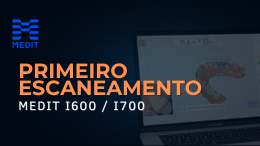
Explore how to manage the steps of intra-clinical 3D scanning to optimize workflows and add data such as pre-operative information.
MEDIT Link: Optimizing Workflow with Intraoral Scanning
In the daily routine of a clinic, every minute counts. Dealing with conventional impressions, chair time, rework, and uncertainty about final precision are frustrations that directly impact productivity and profitability. Digital dentistry, once seen as a distant future, is now a reality that offers tangible solutions to these silent pains, transforming clinical and laboratory routines.
📊 Quick Technical Summary
The use of a MEDIT i600 Intraoral Scanner integrates various workflow steps, allowing the addition of multiple data such as pre-operative and provisional information, optimizing the scanning process and the precision of diagnosis and planning. The 10.9 μm (±0.98 μm) calibration for a full arch ensures superior results.
- Average Accuracy: 10.9 μm (±0.98 μm) for full arch
- Scanning Speed: Up to 35 FPS (continuous 3D video capture)
- Workflow: Open (STL, OBJ, PLY) with Medit Link software included
- Application: Prosthetic rehabilitation, restorative dentistry, and orthodontics
Opening: The Clinic's Rhythm and the Search for Security
It's a truth that, often, routine crushes. The need to optimize every procedure, ensure quality, and reduce chair time is not a luxury, but a requirement for any dental office or prosthetic laboratory. Rework, impression inaccuracy, the anxiety of delivering impeccable work on time... all of this consumes energy and resources. No one wants to have to redo a case due to a lack of precise data or a poorly executed scan.
The insecurity about the fidelity of the final model, the difficulty of integrating different patient information into a single plan, and the hidden cost of lost materials and time are common scenarios. The solution cannot be another problem, but rather a tool that simplifies and brings predictability.
Development: The Logic Behind Digitalization
The idea of scanning the patient and having all the information in a digital environment is not new, but how it is managed makes all the difference. Being able to add a pre-operative scan of the maxilla, mandible, or even scan provisionals and mockups to copy, is something that makes sense. It's reality. If the patient uses a removable denture, the ability to digitize it and use that data in planning is a practical advance.
And when it comes to intraoral scanning, the concern for details is constant. What to do with the gingiva? How to capture only the teeth when necessary? These are questions every professional asks. Having intelligent filter options for teeth and gingiva, or just teeth, or even denser gingiva, is the direct answer to these needs. It's the tool adapting to clinical reality, not the other way around.
The scanning routine also needs to be fluid. Starting with the molars, zigzagging through the anteriors, returning through the occlusal, is a strategy that is learned and applied. And the possibility of doing this in quadrants, in partial models, without losing precision, demonstrates that technology is designed for the real use of the dentist.
Integrating Data for a Complete Diagnosis
Managing steps in MEDIT Link software is fundamental. It's not just about scanning, but about integrating. The ability to add pre-operative data for maxilla and mandible, accurately record occlusion, and even have the flexibility to scan provisionals or removable dentures, changes the game. These are data that, in the past, required multiple procedures and the risk of inconsistency. Now, they are there, ready to be used. The MEDIT i600, with its average accuracy of 10.9 μm (±0.98 μm) for a full arch, provides the solid foundation for this integration.
Having an misalignment checker and the option to manually align occlusion, if necessary, demonstrates a deep understanding of clinical challenges. No one is immune to a small error or an atypical situation. The tool needs to provide support in these moments, not create more complications. Being able to switch between maxilla and mandible if there is a scanning error avoids losing all the work, which is a huge relief for any professional.
Discover the MEDIT i600 Intraoral Scanner: Precision and Efficiency in Your Hands
With an average accuracy of 10.9 μm (±0.98 μm) for a full arch, the MEDIT i600 redefines the standard in intraoral scanning. Its 35 FPS ensure fluidity and speed, while 8-bit Full Color capture offers an incomparable wealth of anatomical details. Lightweight, ergonomic, and with an autoclavable tip, the i600 is the ideal choice for those seeking freedom and efficiency in the digital workflow. With no mandatory monthly fee and Medit Link software included, it is compatible with major CAD/CAM software and 3D printers via STL, OBJ, and PLY files. Invest in the precision that transforms your practice.
See more about the MEDIT i600Clarity and Decision Block: The Value of Investment
By integrating a system that allows managing all this information, from pre-operative to occlusion, the professional is not just buying equipment. They are investing in diagnostic clarity, planning security, and consequently, in a predictable financial return. The ability to record multiple types of occlusion, such as maximum intercuspation or centric relation, and have this data saved in the project, is a differential that optimizes the work of the dentist and the prosthetic laboratory.
It's clarity, investment security, and predictable financial return. When a system allows aligning occlusions with the occlusal plane and even with virtual articulators, it not only speeds up the process but elevates the quality of the work delivered. It is the certainty that each step has been carefully thought out and executed.
Closing: The Conscious Choice
Deciding which technology to incorporate into the clinic is a choice that goes beyond price. It's about trust, efficiency, and the ability to deliver the best for the patient. Digital dentistry, when well applied, is not a fad, but a point of no return for those seeking excellence. It offers the tools for the professional to focus on what truly matters: oral health care and the satisfaction of their patients, with the security of an optimized and predictable workflow.
[[ASSINATURA_AUTOR]]Vídeos relacionados
Perguntas Frequentes
What is MEDIT Link?
MEDIT Link is a tool that manages the steps of intra-clinical 3D scanning, optimizing workflows in digital dentistry.
What problems in conventional dentistry does MEDIT Link solve?
It solves frustrations such as time-consuming conventional impressions, prolonged chair time, rework, and inaccuracy, directly impacting productivity and profitability.
How do the MEDIT i600 Intraoral Scanner and MEDIT Link optimize workflow?
The MEDIT i600 Intraoral Scanner, integrated with MEDIT Link, allows the addition of multiple data such as pre-operative and provisional information, optimizing the scanning process and the precision of diagnosis and planning. It has a calibration of 10.9 μm (±0.98 μm).
What is MEDIT Link?
MEDIT Link is a tool that optimizes the workflow with 3D intraoral scanning, allowing the management of various clinical steps.
What problems are solved with the use of MEDIT Link and intraoral scanning?
It solves frustrations such as conventional impressions, prolonged chair time, rework, and uncertainty about final precision, impacting productivity and profitability.
How does the MEDIT i600 Intraoral Scanner contribute to the workflow?
The MEDIT i600 Intraoral Scanner integrates various steps, allowing the addition of multiple data, such as pre-operative and provisional information, optimizing the scanning process and the precision of diagnosis and planning.
What is MEDIT Link?
MEDIT Link is a tool to optimize the intraoral scanning workflow, allowing the management of intra-clinical 3D scanning steps and the addition of data such as pre-operative information.
What problems does MEDIT Link solve in the clinic?
It minimizes frustrations with conventional impressions, chair time, rework, and lack of precision, positively impacting the clinic's productivity and profitability.
Which intraoral scanner is mentioned for use with MEDIT Link?
The MEDIT i600 Intraoral Scanner is mentioned, integrating various steps of the workflow and optimizing the scanning process.