MEDIT Link: Hybrid Scanning - Improving Core Capture
Discover how hybrid scanning enhances core capture, combining intraoral and impression scanning to overcome depth challenges.
Discover how hybrid scanning enhances core capture, combining intraoral and impression scanning to overcome depth challenges.
Hybrid Scanning with the MEDIT i600 Intraoral Scanner: Precision in Difficult Details
Anyone who works daily with prosthetic rehabilitations knows that not every preparation is a textbook picture. There are those complex cases, with difficult-to-access depth, where the scanner light simply doesn't reach with the necessary clarity. It's frustrating, isn't it? That silent rework, the insecurity about the margin, the hidden cost of time and material.
How many times have you found yourself wondering how to achieve a perfect capture for a core, for example, where every micrometer makes a difference? Clinical reality imposes challenges that demand more than a single solution. We need tools that adapt to our routine, not the other way around.
📊 Quick Technical Summary
Hybrid scanning, using the MEDIT i600 Intraoral Scanner, combines intraoral precision with impression capture, overcoming depth challenges in complex preparations. It ensures an average accuracy of 10.9 μm (±0.98 μm) for a full arch, optimizing the digital workflow.
- Average Accuracy: 10.9 μm (±0.98 μm)
- Speed: Up to 35 FPS with continuous capture
- Color: 8-bit depth (full color)
- Main Application: Scanning of cores and deep preparations
At such times, the ability to combine the best of two worlds proves essential. Hybrid scanning emerges as a response to this need, allowing the digital capture of an impression to complement direct intraoral scanning. It is an intelligent strategy to ensure that no vital information is lost or compromised, especially in regions where light penetration is an issue.
📋 Detailed Clinical Protocol for Hybrid Scanning with MEDIT i600
This protocol details the hybrid scanning technique using the MEDIT i600 Intraoral Scanner to optimize the capture of deep preparations and cores, ensuring complete and accurate digital data.
Required Materials and Equipment:
- MEDIT i600 Intraoral Scanner
- Precision impression material
- Medit Link Software
Step-by-Step Procedure:
- Step 1: Initial Arch Scan Perform a complete scan of the patient's arch with the MEDIT i600, including the preparation area. Be sure to capture the upper arch and the antagonist, ensuring a robust initial model.
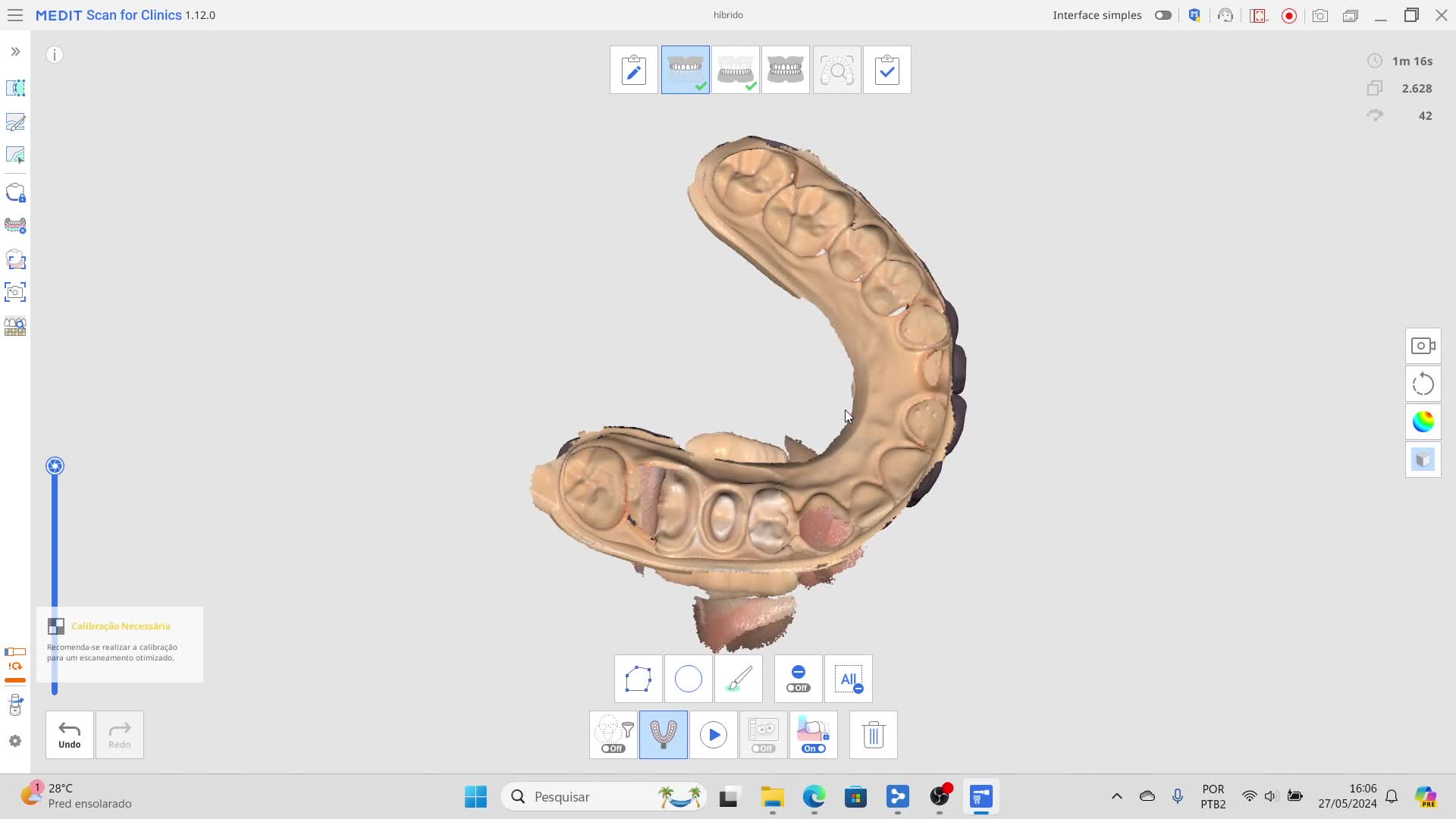
- Step 2: Activate Hybrid Scanning After completing the arch scan, activate the “Impression Scan” tool (impression scanning) in the Medit Link software. This function will invert the model mesh, preparing it for the next step.
- Step 3: Scan the Impression in the Region of Interest Scan only the region of interest of the impression, which corresponds to the deep preparation or core. Focus on the area that needs complementation due to difficulty of access or depth.
- Step 4: Artifact Trimming It is crucial not to confirm the operation immediately after scanning the impression. Activate the trimming tool to remove artifacts and unwanted areas that were captured. Use the polymer or multipoint tool to preserve only the preparation area (e.g., element 15), ensuring a clean and precise mesh.
- Step 5: Finalization and Case Sequence After trimming and cleaning the impression mesh, finalize the impression acquisition tool. The software will integrate the refined impression scan with the original intraoral scan, resulting in a complete and accurate digital model of the preparation. Continue the case with antagonist scanning and occlusion registration.
⚠️ Points of Attention:
- The accuracy of the impression is fundamental for the success of hybrid scanning.
- Careful trimming of artifacts prevents pollution of the digital mesh, maintaining the integrity of the model.
- The MEDIT i600, with its open architecture and STL, OBJ, PLY formats, ensures compatibility with major software and 3D printers.
💡 The Solution that Makes Sense in Digital Dentistry
This approach is not just a “tip”. It is a strategy that reflects the experience of many professionals. Experience shows that, in cases such as core scanning, where the light penetration area is very small, complementing with the impression becomes a very interesting aid. It is not about replacing one technique with another, but about integrating them to obtain the best possible result.
It is having the certainty that, when delivering a job to the laboratory, the digital base is solid, without questionable margins or shadow areas. It is clarity, security in investment, and predictable financial return.
The MEDIT i600 Intraoral Scanner, with its unparalleled clinical accuracy of 10.9 μm (±0.98 μm) for a full arch and scanning capability at 35 FPS, provides the basis for this flexibility. Its open architecture, with STL, OBJ, and PLY export, ensures that the digital workflow is unconstrained, compatible with any CAD/CAM software and 3D printer.
The lightness and ergonomics of the MEDIT i600 (only 245g) and the 180° reversible tip facilitate intraoral access, while its autoclavable capability ensures biosafety. The Medit Link software, with no monthly fee, completes the solution, making prosthetic rehabilitation, restorative dentistry, and orthodontics more efficient.
Transform Your Clinic with the MEDIT i600
Invest in a scanner that offers freedom, precision, and compatibility. Explore the potential of hybrid scanning and elevate the quality of your work.
Learn More about the MEDIT i600✅ Conscious and Professional Decision
Integrating hybrid scanning into your workflow is not about adopting a novelty out of fashion, but about making an informed choice. It is understanding that, for each clinical challenge, there is a technological response that, when applied intelligently, ensures the necessary precision and peace of mind in daily practice. It is the foundation for building a more robust and predictable digital dentistry.
[[ASSINATURA_AUTOR]]Vídeos relacionados
Perguntas Frequentes
What is hybrid scanning in the context of MEDIT Link?
It is the combination of intraoral scanning (with the MEDIT i600) and impression scanning to optimize the capture of cores and other difficult-to-access structures.
What challenges does hybrid scanning seek to solve?
It aims to overcome difficulties in capturing details in preparations with difficult-to-access depth, where the intraoral scanner light may not reach with sufficient clarity, as in cores.
How does hybrid scanning improve core capture?
It combines the advantages of intraoral and impression scanning, allowing for a more precise and detailed capture of cores, where every micrometer is crucial.
What is MEDIT Link hybrid scanning?
It is a technique that combines intraoral scanning and impression scanning, especially useful for capturing details in difficult-to-access or deep preparations.
What are the benefits of hybrid scanning for prosthetic rehabilitations?
It improves the capture of cores and other structures with difficult-to-access depth, ensuring greater precision and reducing the need for rework or uncertainty about the margin.
Which MEDIT equipment is used for the mentioned hybrid scanning?
Hybrid scanning can be performed with the MEDIT i600 intraoral scanner, as mentioned in the context.
What is hybrid scanning in MEDIT Link?
Hybrid scanning in MEDIT Link combines intraoral and impression scanning to enhance core capture, especially in cases with depth challenges.
What benefits does hybrid scanning offer for deep preparations?
It improves the capture of cores in difficult-to-access areas, where the intraoral scanner light may not reach clearly, reducing rework and ensuring margin precision.
Which intraoral scanner is used for the mentioned hybrid scanning?
The described hybrid scanning uses the MEDIT i600 intraoral scanner to obtain greater precision in difficult details.